Mindsets: Chess in Education Pre-Conference Reception
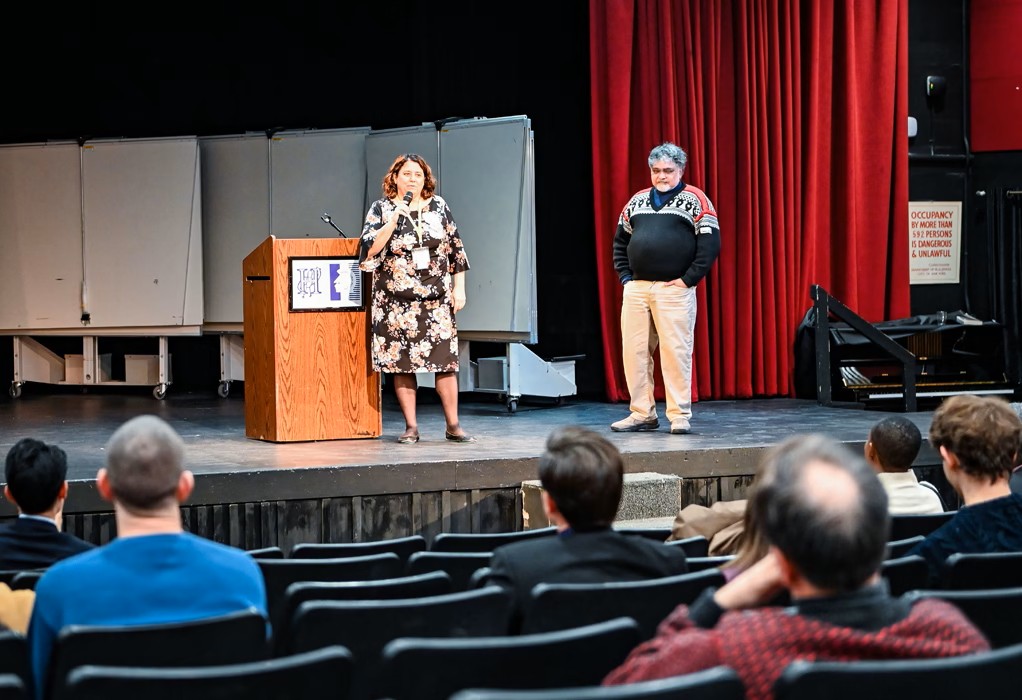
Dawn Roy & FIDE Master Sunil Weeramantry at the pre-conference reception, Mindsets: Chess in Education. Photo by John Brezina, courtesy of the National Scholastic Chess Foundation (NSCF).
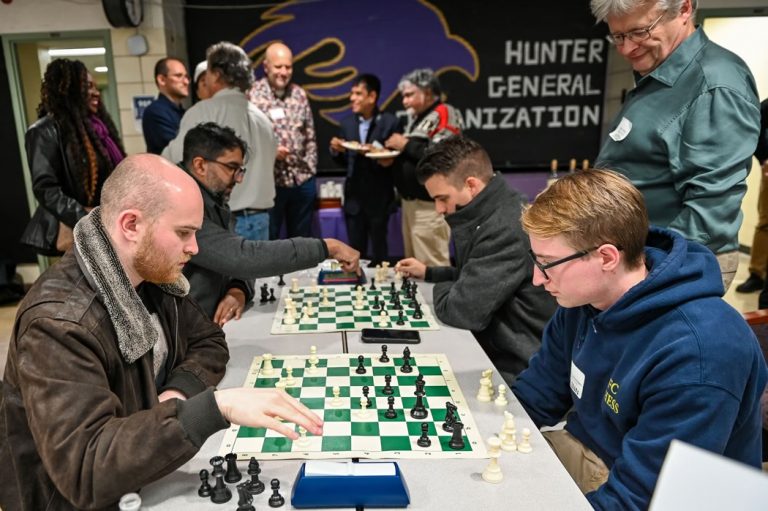
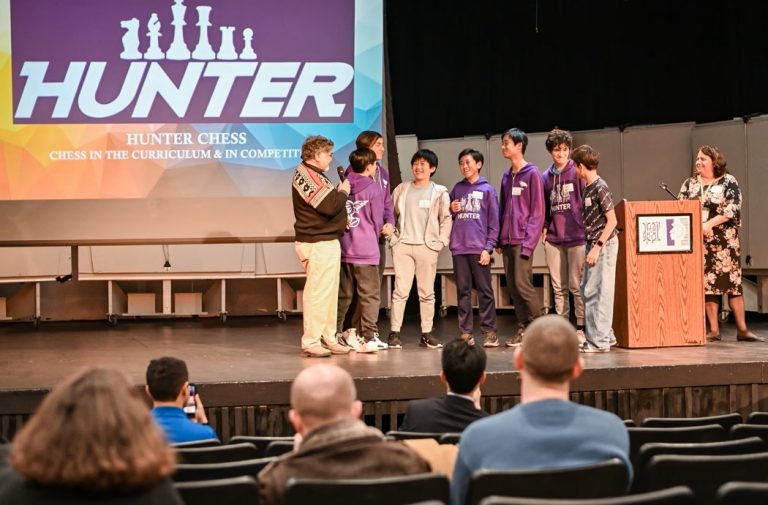
Stepping into the auditorium during the pre-conference reception felt like entering the heart of the event. The room buzzed with quiet excitement—educators, coaches, organizers, and supporters of scholastic chess greeting one another, exchanging stories, and reconnecting. The stage was set with a large screen displaying the Hunter Chess in the Curriculum & in Competition logo, reminding us that this wasn’t just an event at a school—this was an event hosted by a school where chess is integrated into daily life. Something I wasn’t aware would happen at the reception at all, therefore I was very glad that I chose to accept the invitation to attend.
As the evening officially began, Dawn Roy, Principal of Hunter College Elementary School, stepped forward to welcome everyone.
Photo by Julianna Dawson
Warm, poised, and confident, she set the tone beautifully by introducing the Head of the Campus school’s Dr. Lisa Siefmann, who spoke in a brief video to the audience of the deep roots of chess within the Hunter College Campus Schools — not as an enrichment, but as part of the institution’s identity. Referencing a 1992 publication, The Hunter College Campus Schools for the Gifted: The Challenges of Equity and Excellence, it was noted that chess appeared on the cover because it had already become foundational to how students learn, think, and belong. Chess was described not only as a K–6 requirement, but as a K–12 pipeline — one that brings together students of varying backgrounds and experience levels, sustains advanced instruction, and leaves a lasting imprint on alumni long after graduation.
After the conference weekend ended, I took time to re-listen to a video clip I was able to capture during the reception. I remembered hearing several moments I wanted to bring back and share with the parents in our chess program who could not be there themselves. What follows is a transcript I created by listening carefully and typing what I heard. If a full video is released later, and time permits, I’ll be happy to return and update this section for parents who would like more detail.
Transcript (excerpted from video shown during the pre-conference reception):
[On screen, the book mentioned was held up as she spoke]
“… A 1992 book by a teacher called The Hunter College Campus Schools for the Gifted: The Challenges of Equity and Excellence — and of course, what’s on the front cover?
Students playing chess.
Because chess education is such a fundamental part of our DNA.”
“They recognized chess as they went forth to talk about so many of the other challenges of equity — and I know those conversations continue in chess education today.”
“I want to express my profound personal and professional gratitude to Sunil Weeramantry, to his Grandmasters, to his chess teachers, to our parents, to our incredibly visionary Elementary School Principal Dawn Roy, and to the hundreds and thousands of chess alumni from the Campus Schools, who continue to show the vitality of this education and its importance to students as they learn how to think, how to play, and how to be part of this really special community.”
“We are so fortunate to be able to provide chess education as part of our mandatory elementary curriculum. But we have also found the necessity — and great pride — in continuing that through Grades 7–12.”
“When students transition into middle and high school, we triple our population. Some students arrive as advanced players. Others are completely new. Chess becomes a way for students from all over the city to join first through social dynamics — and then continue developing at every level.”
“For advanced students, that education continues as well. I believe Sunil told me he’s even brought in a new Grandmaster — all the way from New Jersey.”
“This is part of a K–12 pipeline that sustains our chess experience.”
“As someone who works closely with our alumni, I can tell you how often they speak about the profound impact chess had on their lives — beginning in elementary or high school, and continuing through higher education and beyond. So, we know this work is worth working for and fighting toward.”
“Thank you for being part of this movement — for being the people who will help ensure chess education is available to as many students, in as many places as possible.”
“We’re so proud of Sunil and the work he has done — both here and throughout the chess community. There are two videos we’d like to share: one clip from Sesame Street featuring a student arriving for chess instruction, and another highlighting Sunil’s ongoing work.”
“I’m going to ask that we play those now. I wish you a wonderful weekend. I know this conference will be fantastic. Thank you again for taking the time to be here at the Campus Schools.”
[The audience responds with a round of applause.]
Transcript (excerpted from a Sesame Street video clip shown during the pre-conference reception):
JD (a child who is a student): “My dad’s taking me to school…”
Dad: “So you play chess this week?”
JD: “Yeah!”
Dad: “What day do you practice chess?”
JD: “Mondays and Wednesdays.”
Dad: “So you pay attention to Sunil, okay. I’ll see you this afternoon.”
[He hugs his son goodbye.]
[The Sesame Street clip transitions to a much younger Sunil at a demonstration board, teaching kindergarten students seated on the floor.]
Sunil: “Knight on g5…”
[The child narrates as the lesson continues.]
JD: “That’s Sunil. He’s a Chess Master who teaches us how to play chess.”
Sunil: “I see a strong rook.”
Girl: “d4, Queen…”
Sunil: “That’s very good.”
JD raised his hand and says: “Knight on f7 to h6.”
Sunil: “Oh! Very good. The knight on f7…”
JD (narrating):
“We have knights, kings, and queens. It’s really neat.
Sometimes we get to play on a really big board.”
[The Sesame Street segment shows students playing together on a giant chessboard. We later learn that it was painted on the very auditorium stage we were sitting in front of, with each child contributing a move as part of a team.]
JD:
“This is a chess tournament.
I get to play with a lot of different kids from different schools.
Every game is different, so you really have to pay attention, and sometimes the kids you’re playing wins. I love it!”
“I didn’t win, but I had fun playing.
I can’t wait till the next tournament.”
[At the end of the tournament, Sunil hands out trophies as parents applaud and hug their children while they accept their awards.]
As I continued working with this material in the days that followed the conference, one moment from our own chess community quietly resurfaced. During an after-school program at Orange Avenue Elementary School, I asked the students whether they might be interested in playing chess with children from other schools. One girl immediately spoke up, excited to share that she knew another girl at Mathewson Elementary School who was also in an after-school chess program with us there. Her face lit up at the idea of playing chess with her friend — a small but telling moment. As I reflected on it later, I couldn’t help but wonder whether that enthusiasm was connected to something deeper: at her school, she is the only girl in the chess program, while at the other school there are several girls. Watching the Sesame Street clip again, with its emphasis on participation, joy, and belonging, that moment took on new meaning. It served as a quiet reminder that chess is not only about learning the game, but about creating spaces where children feel seen, connected, and eager to return.