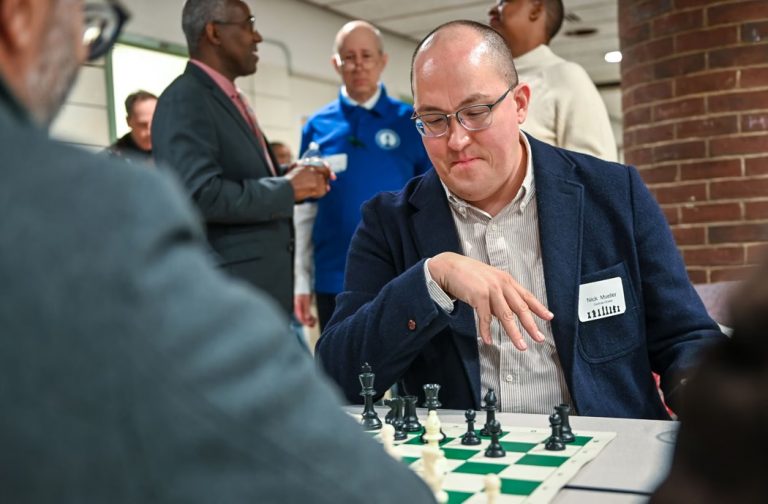
At the Mindsets: Chess in Education Conference
Highlights
This session with Jeff Bulington challenged how we think about teaching chess. It’s not just about the game, but about designing learning experiences that help thinking transfer beyond the board. For us, it led to real changes in our programs, including opening the door to younger students.
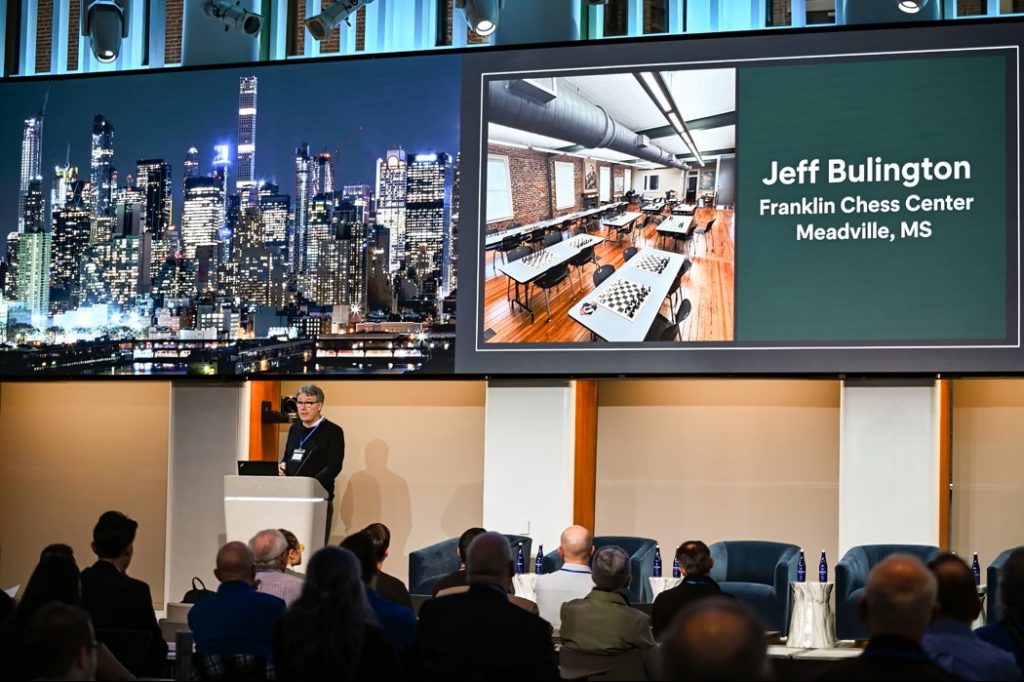
There are moments in a conference when you realize you’re no longer just listening but being challenged.
That’s what this session with Jeff Bulington felt like.
Not a presentation about chess.
Not even a presentation about education.
But something deeper:
A reflection on what it actually means to teach thoughtfully.
Starting with the Right Questions
Jeff didn’t begin with chess.
He began with questions. The kind that quietly reshapes how you see everything that follows.
- Why should we teach this rather than that?
- Who should have access to what knowledge?
- What rules should govern what is taught?
- How should everything connect into a coherent whole?
These questions, drawn from Herbert Kliebard’s Forging the American Curriculum, didn’t feel abstract.
They felt… personal.
Because whether we realize it or not, we answer these questions every time we step into a room with students.
Listening to the People Who Actually Teach
One idea that stayed with me was this:
The most meaningful insights often come from observing experienced instructors, especially chess coaches who have spent years in the room.
Not just researchers.
Not just theories.
But people who have spent years in the room adjusting, responding, and noticing what works and what doesn’t.
It reminded me of something I’ve been experiencing myself and something my husband has been experiencing as well.
There is a difference between knowing something and guiding someone else to understand it.
That difference only becomes visible through experience.
The Transfer Problem (This One Made Me Pause)
Then Jeff introduced a tension that I think many of us have felt, but maybe haven’t named:
Yes, chess teaches thinking…
but why doesn’t that always show up outside the chessboard?
This idea, often referred to as the transfer problem, challenges a common assumption.
We say:
“Chess builds critical thinking.”
But Jeff invited us to ask:
“Under what conditions does that thinking actually transfer?”
Because it doesn’t happen automatically.
It Doesn’t Transfer Unless We Help It
This is where the idea deepened.
The message wasn’t that chess can’t build broader thinking.
It was that:
It won’t transfer on its own.
For students to carry skills like planning, decision-making, and future thinking into other areas of life…
Those connections need to be made visible.
Not assumed.
Not implied.
But intentionally built into how we teach.
How We Structure Learning Matters
Jeff then introduced a framework from Basil Bernstein that gave language to something I hadn’t fully articulated before.
- Classification → how subjects are separated
- Frame → who controls what is taught and how
In simpler terms:
How we organize learning
What we include (and exclude)
And how much control students have
…all shape what students actually take away.
It made me reflect on something very practical:
Even in chess, we’re making decisions like:
- Do we isolate concepts?
- Do we connect them to real-life thinking?
- Do we guide tightly, or allow exploration?
Those choices matter more than we sometimes realize.
Voluntary or Mandatory?
One idea Jeff shared stayed with me. He said, “Our rule at our chess club is you can’t be here unless you want to be here. Come when you’re ready.”
He explained that when they tried making participation mandatory, it didn’t always work as intended. Students who weren’t ready to engage didn’t connect with the experience in the same way.
At the same time, this sparked a thoughtful response from the audience. One educator from Long Island shared that in his community, chess often needs to be mandatory at first, simply because many students would not otherwise be exposed to it. Without that initial introduction, they may never discover its value.
This connected to what we saw the night before at Hunter College Campus Schools, where chess is part of the school experience early on.
Listening to both perspectives, I found myself thinking differently about the question. Perhaps it isn’t simply about whether chess should be voluntary or mandatory, but about timing. When exposure opens the door, and when choice allows students to walk through it.
Since attending this conference, something has already begun to shift in our own work. Prior to attending, most of the children in our program were in the early elementary years, although parents had asked about including younger children. We had even seen a few younger students try to join, but they often needed more support than a group setting allowed at the time.
Since returning, we’ve made a change. We’ve begun to include kindergarten after seeing what is possible when younger students are supported in a group setting.
Making Meaning, Not Just Moves
One of the most memorable moments came through something unexpected:
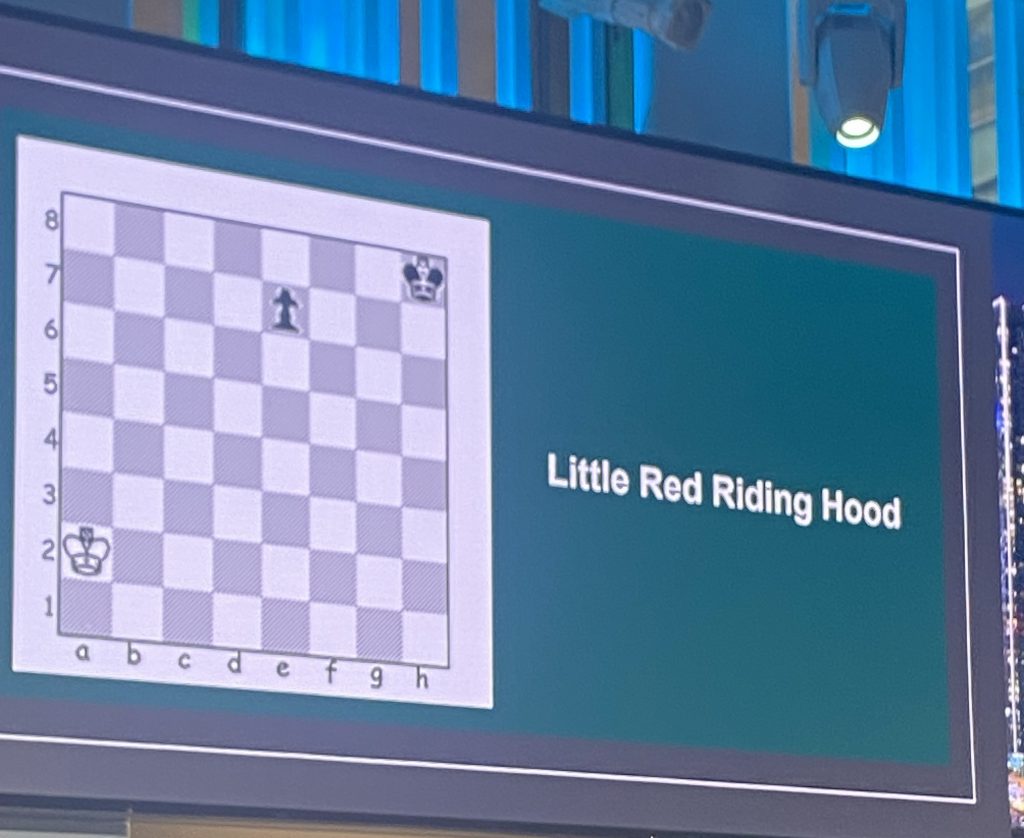
A chess position paired with the title:
“Little Red Riding Hood.”
At first, it felt surprising.
But then it clicked.
Jeff shared an endgame position and explained that he instructs his students this way:
“You’re the general of this army. Now you have to write a letter to his parents explaining why you let their son die.”
There was a reaction in the room. A kind of collective intake of breath. More like an electric moment, the instant when you realize what just happened.
In a single sentence, he had shifted the exercise from solving a position to taking responsibility for a decision.
You could feel it land.
As a chess coach, I understood immediately why his students would not forget that moment.
This wasn’t just about solving a position.
It was about:
- interpretation
- narrative
- meaning
It showed that learning can move beyond “Find the best move”
into questions like:
“What is happening here?”
“What story does this position tell?”
That shift opens a completely different kind of thinking.
Why This Matters Right Now
Jeff also grounded the conversation in a broader reality.
A slide shared recent NAEP (National Assessment of Educational Progress) Grade 12 math results showing:
- only a small percentage of students reaching proficiency
- many performing below basic levels
It wasn’t presented as criticism.
It was presented as context.
A reminder that:
- What we’re doing in education isn’t consistently producing the outcomes we hope for.
And that invites a bigger question:
- Not just what we teach
- But how we design learning experiences in the first place
What I’m Taking with Me
What stayed with me most wasn’t a single idea.
It was a shift in perspective.
A reminder that teaching chess, or anything, is not just about:
- content
- positions
- or even skill development
It’s about:
- Designing experiences where thinking becomes visible
- Helping students connect ideas across contexts
- Being intentional about how learning unfolds
Because if we don’t…
Students may become very strong within the game…
but never fully experience what it can offer beyond it.
A Quiet Reflection
As I sat there, I found myself thinking about the students I work with each week.
The ones who:
- think deeply
- approach problems in their own way
- sometimes want to explore before being told
And I realized:
This session didn’t just give me ideas.
It gave me language for things I’ve already been noticing.
And maybe more importantly…
It reminded me to keep asking:
- Not just “What am I teaching?”
- But “What kind of thinking am I helping to develop?”
Before I go, I want to share one more important thing Jeff noted. He shared that in some cases, chess existed outside the school day entirely, offered before school, during lunch, and/ or after school as an extracurricular or enrichment activity. This raised important questions about where and how this kind of learning fits within education.
David and I currently run after-school chess programs in Milford and have done these programs at seven of the eight elementary schools so far. We also offer group chess coaching at the Margaret Egan Recreation Center on Monday evenings, as well as annual or biannual workshops at the Milford Public Library. But after seeing programs like the one at Hunter College Campus Schools at the pre-conference reception the night before (see Day 1, Part 3), and hearing about programs in New Jersey and Greenwich, Connecticut, we found ourselves thinking about what might be possible to build in the coming years in Milford.
Jeff also shared a story that stayed with me. He said he once pointed to a rundown building in his town of 423 people and told someone, “That would make a great chess club.” Time passed, and one day he received a call from that same person, who said, “You know that building you mentioned? I’m going to send an architect down, and you can tell him how you want it to look.”
The donor asked to remain anonymous.
At the conference, a student read a letter of gratitude to the donor’s family, describing the impact that chess club had on his life and the lives of many others in the community. Jeff said he thought of the chess club as an academic sports team.
It was a powerful reminder that sometimes we think we’re just building a place to play chess, when in reality, we are bringing people together. Chess becomes the frame for something larger. The scaffolding upon which a connected community may continue to grow.
That is the hope we have for our fellow neighbors, friends and families in Milford, the town we call home.
Related Resources:
Why Teach Chess in Schools (URL: https://nscfchess.org/why-teach-chess-in-schools/ )